Research
Active Research Projects
Cross-flow turbines in the presence of waves
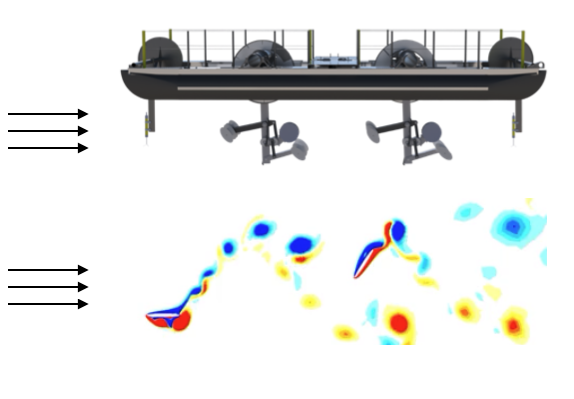
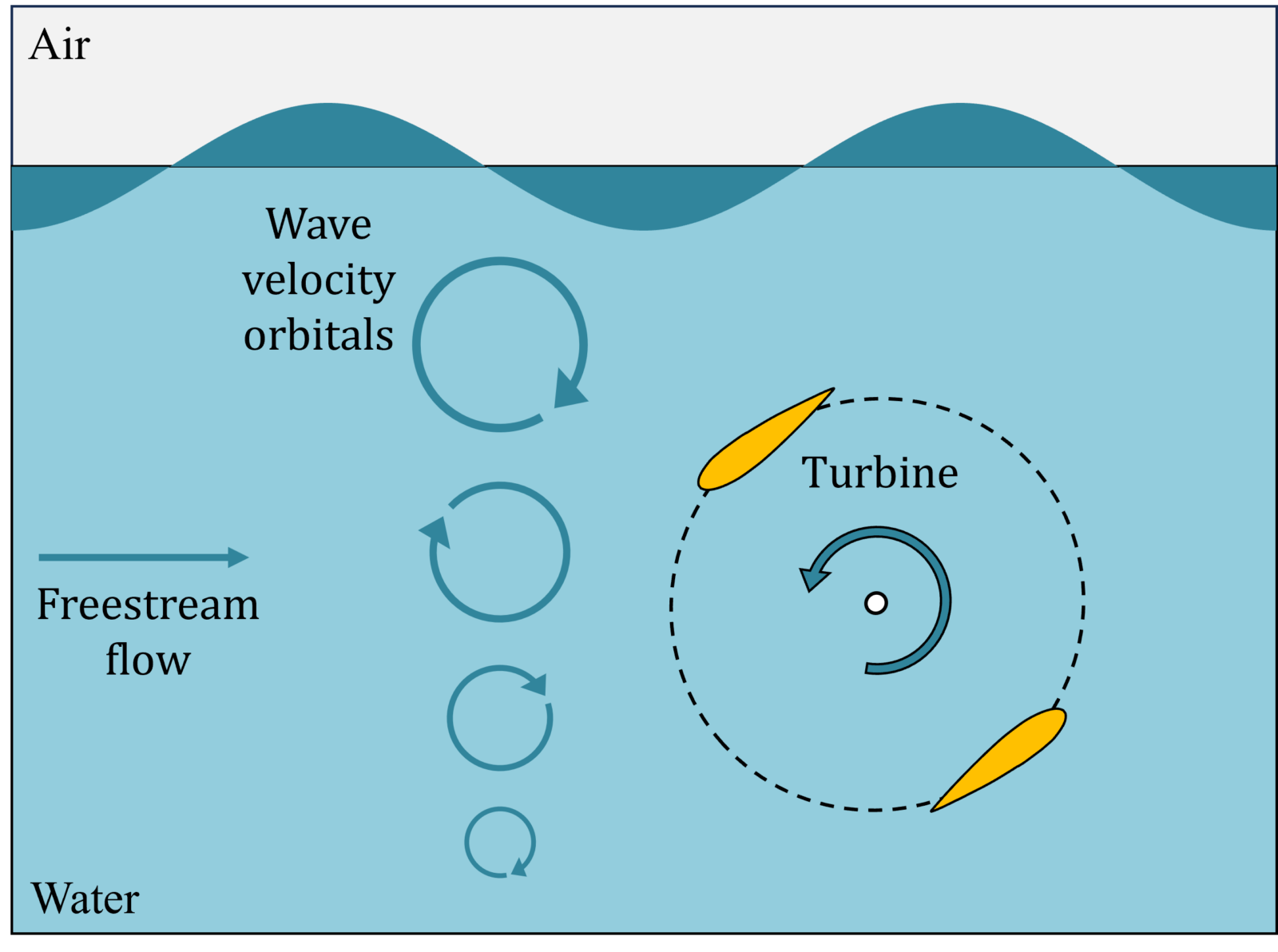
Cross-flow turbines are an alternative to traditional axial-flow turbines for harvesting marine energy from tidal channels. However, most tidal channels are shallow, and deployment is likely to be close to a free surface where wind-driven waves can impact performance. These simulations couple wave motion with turbine dynamics, fully resolving the air-water interface alongside linear wave inputs. Collaborators: Nimish Pujara (U. British Columbia)
Convection and transport in ice-covered lakes
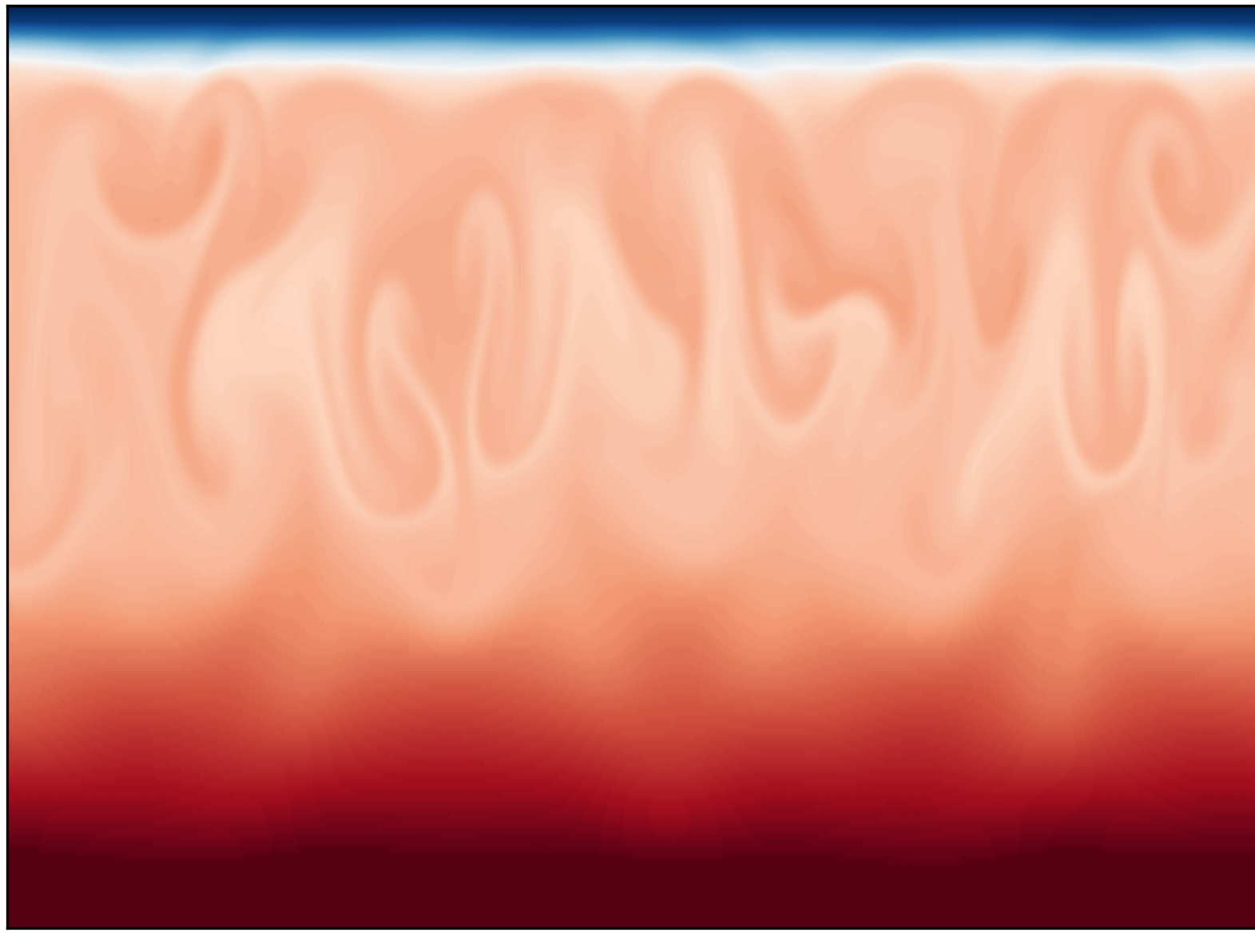
Although lakes are covered in ice, the water underneath can still have motion, stirring up particles and nutrients and impacting flora and fauna such as algae. This motion is primarily driven by the diurnal cycle of the sun, which heats the fluid and causes instabilities and mixing. This research uses mathematical modeling and detailed fluid simulations to predict the dynamics. Collaborators: Till Wagner, Nimish Pujara (U. British Columbia)
Cross-flow turbines near boundaries and turbine-turbine interactions
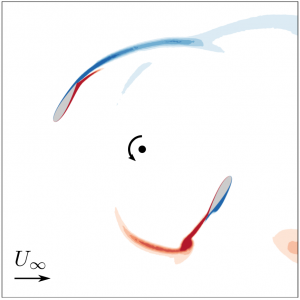
The performance of cross-flow turbines is modified when placed in proximity to a free surface, solid surface, or other turbines. This project explores the physical mechanisms behind these scenarios, which often occur in turbine deployment (DOE). Collaborators: Brian Polagye, Aidan Hunt, Owen Williams (U. Washington)
Mitigation of vortex-foil interactions with passive flexibility
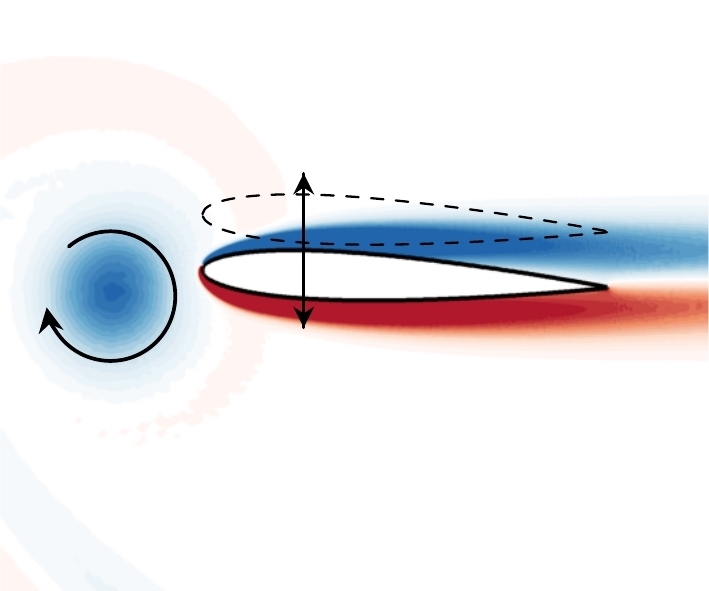
When lightweight and unmanned aircraft maneuver around complex terrain, they are often strongly impacted by vortex gusts. This project simulates the impact of a vortex gust on a chordwise flexible airfoil that is passively heaving and/or pitching. It incorporates a fully coupled FSI scheme along with a moving mesh to accurately capture the coupled solid mechanics and unsteady fluid flow (AFOSR). Collaborators: Kenny Breuer (Brown University)
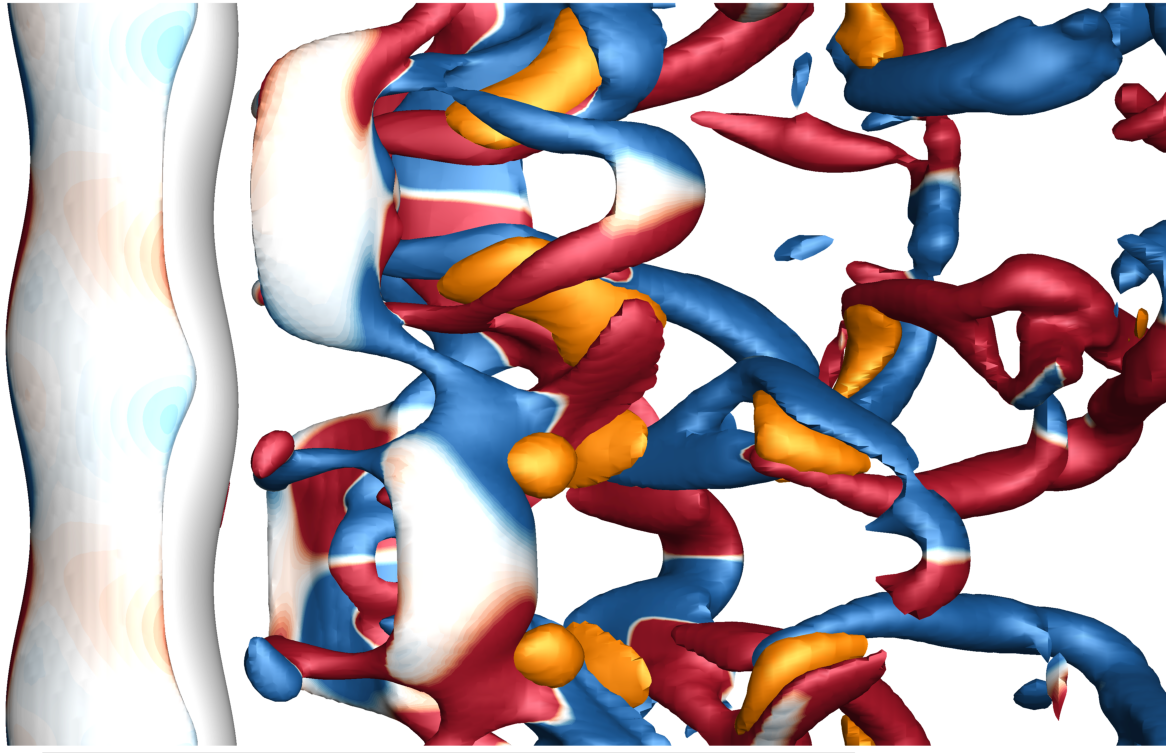
Flow over seal whiskers
Unlike other mammals, seals have undulations, or bumps, on their whiskers, which allow for excellent prey-tracking abilities. We are interested in understanding the wake structures and flow dynamics that govern the flow over seal whiskers (NSF, SMART). Collaborators: Raul B. Cal (Portland State) and Christin Murphy (NUWC-Newport)
- Dunt et al, 2026. Bioinspiration and Biomimetics
- Dunt et al, 2024. Bioinspiration and Biomimetics
- Ferčák et al, 2023. Bioinspiration and Biomimetics
- Lyons et al, 2023. Theor. Comput. Fluid Dyn.
- Dunt and Franck, 2022. AIAA 2022-3982
- Yuasa et al, 2022. Fluids and Structures
- Lyons et al, 2020. PLOS ONE
Modeling and predicting wake-foil interactions for oscillating hydrofoils
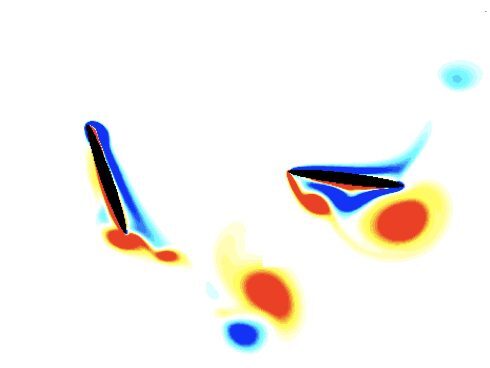
Oscillating foils are a bio-inspired option for harvesting energy from moving waters such as tidal channels, rivers, or ocean currents. However, they will work best if deployed in compact arrays of multiple foils. This research aims to model and optimize the wake-foil interactions that will enable multiple oscillating foils to benefit from the coherent vortex wake of their neighbors (NSF).
Previous Research Projects
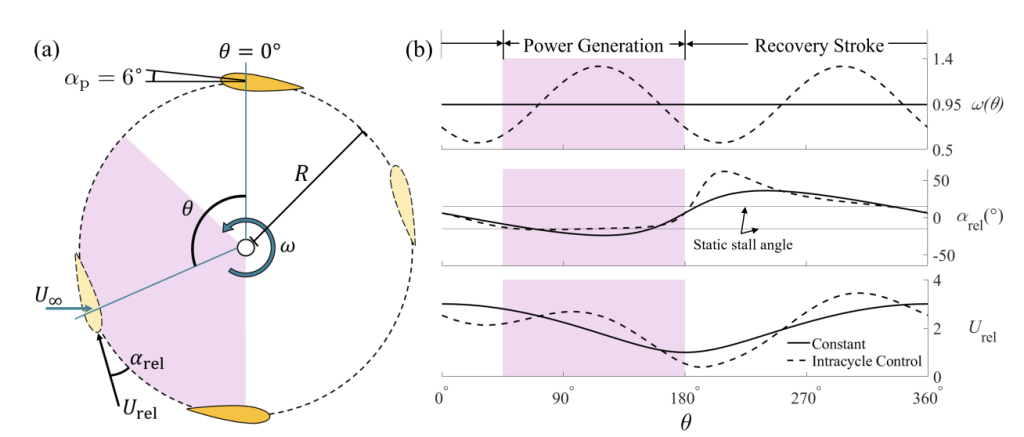
Cross-flow (vertical-axis) turbine dynamics (ARPA-E, DOE)
- Athair et al, 2026. Wind Energy
- Snortland et al, 2025. Fluids and Structures
- Hartke et al, 2025. Renewable and Sustainable Energy
- Dave and Franck, 2023. Physical Review Fluids
- Dave et al, 2021. AIAA Journal
- Dave et al, 2020. AIAA 2020-0348
- Bridges et al, 2022. AIAA 2022-4139
- Dave and Franck, 2021. Renewable and Sustainable Energy
Vortex and wake dynamics of oscillating foils for marine energy (NSF, ARPA-E)
- Ribeiro and Franck, 2023. AIAA Journal
- Ribeiro and Franck, 2022. AIAA 2022-4140
- Lee et al, 2022. Physical Review Fluids
- Ribeiro et al, 2021. Physical Review Fluids
- Calvet et al, 2021. Biomimetics and Bioinspiration
- Ribeiro and Franck, 2021. AIAA 2021-2947
- Ribeiro et al, 2020. Fluids and Structures
- Simeski and Franck, 2017. Marine Energy Technology Symposium