The CFPM lab is actively involved in Marine Renewable Energy Research, mostly investigating in-line hydrokinetic energy generation from rivers, tidal flows, and ocean currents. Our capabilities provide high-fidelity computational fluid dynamics (CFD) of time-dependent and unsteady hydrodynamics at the rotor/blade level, and also within the wake. This includes fluid-structure interactions and active control of geometry and/or kinematic motion.
A sample of current and previous projects are illustrated below, but you can also see more research through our publications.
Simulations of Cross-Flow Turbines
Dynamic stall : Accurate simulation of the fluid mechanics around the blade is critical to properly model dynamic stall. The abrupt separation and reattachment of the boundary layer significantly impacts energy generation of cross-flow turbines. Our research utilizes a combination of large-eddy simulation (LES) and unsteady Reynolds-averaged Navier-Stokes (URANS) solvers to robustly model and predict this unsteady phenomena.
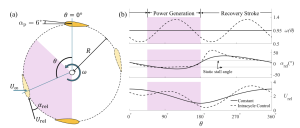
Intracycle control : Simulations of cross-flow turbines are performed to look at the vortex dynamics within the cycle, and how the performance can be enhanced by actively modifying the angular velocity. By applying a sinusoidal angular velocity profile, the power coefficient is increased by modifying the vortex dynamics and relative flow vectors. Continued work in this area includes blockage/confinement effects, and assessment of various modeling strategies (e.g. RANS vs. LES). Experimental collaborators include Professors Brian Polagye and Owen Williams at the University of Washington.

Boundary and blockage effects: When marine energy harvesters are placed in confined channels (e.g. rivers or tidal flow constrictions), the performance is impacted by blockage and boundaries, such as channel walls, ground effects, or the free surface. Our simulations have investigated how the performance of cross-flow turbines can be optimized within these conditions.
Free surface and waves: Our simulations can also directly model the free surface and its two-way interaction with a cross-flow turbine, including the impact of linear waves within the domain.
Oscillating Foil Arrays
 Oscillating foils in a heaving and pitching motion are able to generate energy from an incoming flow in a similar manner as traditional rotation-based turbines. Unlike traditional turbines, they leave behind a structured wake from the large, coherent vortices shed at each half-cycle. Research is being performed into how to optimize the kinematics and configurations of close-packed arrays of oscillating foils, in order to improve the energy density. Computational fluid dynamics is utilized along with machine learning techniques. Experimental collaborators include Professor Kenny Breuer at Brown University.
Active On-Blade Flow Control

High Reynolds number (Re=400,000) large-eddy simulations (LES) are utilized to investigate the effect of dielectric barrier discharge (DBD) plasma actuators in the boundary layer of a wind turbine airfoil. Various actuation strategies along the trailing edge are explored in order to modify the lift curve, which can be utilized to mitigate unsteady loads on blades in off-design conditions. Collaboration with Arctura Inc (formally Aquanis).